The 20 Ogham Letters: A Woodland Guide to Divination
Now that we’ve wandered through the history of Ogham, it’s time to meet the letters themselves!
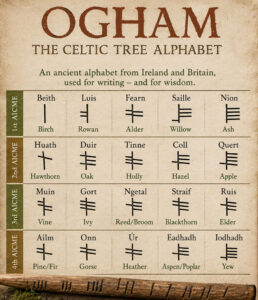
The traditional Ogham alphabet contains 20 primary letters, divided into four groups of five called aicmí (pronounced roughly ECK-mee). Each letter has a name, a sound, and a long history of interpretation.
In modern witchcraft and Pagan practice, these letters are often connected with particular trees and plants, and each has developed its own collection of symbolic and divinatory meanings.
There is one little historical footnote before we begin: although Ogham is often called the “Celtic tree alphabet,” the idea that every letter originally represented one specific tree isn’t quite as simple as modern divination books sometimes suggest. Medieval Irish sources give several different types of associations, and some of the tree identifications remain debated.
The meanings below are therefore best understood as modern divinatory interpretations inspired by historical Ogham traditions, Celtic symbolism, and contemporary Pagan practice.
Think of them as a starting point rather than a rulebook. Your own experiences with the trees and plants around you can become part of your interpretation too.
So, let’s step into the woods!
The First Aicme: B, L, F, S, N
The first group contains five letters traditionally associated in modern practice with birch, rowan, alder, willow, and ash.
1. Beith — Birch
Sound: B
Tree: Birch
Themes: New beginnings, renewal, purification, fresh starts
Birch is often associated with beginnings and the clearing away of the old to make room for something new. It is one of those trees that seems to say, “Right then, let’s start over!”
In divination, Beith may appear when you are entering a new chapter of life or when an old situation needs to be left behind.
It can suggest:
- New opportunities
- Fresh starts
- Personal growth
- Letting go of the past
- Cleansing and renewal
If Beith appears in a reading, it may be time to stop staring at the closed door and notice the one that’s just opened.
2. Luis — Rowan
Sound: L
Tree: Rowan
Themes: Protection, intuition, magic, resilience
Rowan has a long association with protection and folklore. Its bright red berries and distinctive appearance have helped make it a favourite in magical traditions.
In divination, Luis may indicate a need for protection – physical, emotional, or spiritual. It can also point toward trusting your intuition and paying attention to those little inner nudges.
It may suggest:
- Protection from negativity
- Strong intuition
- Magical awareness
- Courage
- Resilience
- Trusting your instincts
Luis is the sort of stave that reminds you that you probably know more than you think you do.
3. Fearn — Alder
Sound: F
Tree: Alder
Themes: Courage, strength, leadership, determination
Alder grows happily in wet environments and is known for its relationship with water. In Celtic mythology, it also has connections with warriors and heroic figures.
In divination, Fearn can represent courage in difficult circumstances. It may appear when you need to stand your ground or take responsibility for a situation.
Its messages may include:
- Be brave
- Take the lead
- Stand firm
- Face the challenge
- Trust your inner strength
Fearn doesn’t necessarily promise that the road ahead will be easy. It simply suggests that you’re stronger than you may currently believe.
4. Saille — Willow
Sound: S
Tree: Willow
Themes: Intuition, emotions, dreams, adaptability
Willow has a wonderfully watery quality. Its branches bend and move with the wind, and it often grows beside rivers and lakes.
In divination, Saille can represent emotional depth, intuition, dreams, and the ability to adapt to changing circumstances.
It may suggest:
- Listen to your intuition
- Pay attention to dreams
- Allow emotions to flow
- Be flexible
- Accept change
Saille reminds us that strength doesn’t always mean standing rigidly against the storm. Sometimes strength means bending without breaking.
5. Nion — Ash
Sound: N
Tree: Ash
Themes: Connection, balance, transformation, the wider world
Ash is a powerful and important tree in mythology, particularly in Norse tradition, where Yggdrasil is an immense world tree. Ash also has significance in Celtic traditions and folklore.
In modern Ogham divination, Nion is often associated with connection and the relationship between different parts of life.
It may point toward:
- Finding balance
- Connecting ideas
- Personal transformation
- Understanding your place in the world
- Seeing the bigger picture
Nion encourages you to look beyond the immediate problem. Sometimes the puzzle only makes sense when you step back and see the whole picture.
The Second Aicme: H, D, T, C, Q
The second group is traditionally associated in modern practice with hawthorn, oak, holly, hazel, and apple.
6. Huath — Hawthorn
Sound: H
Tree: Hawthorn
Themes: Boundaries, protection, challenge, the Otherworld
Hawthorn has a particularly interesting place in Celtic folklore and is often associated with the mysterious Otherworld. Traditional stories sometimes warn against disturbing lone hawthorn trees, especially those growing in unusual places.
In divination, Huath can indicate a threshold or a challenge. You may be standing between one stage of life and another.
It can suggest:
- A test or obstacle
- Setting boundaries
- Hidden possibilities
- Transformation
- Respecting the unknown
Huath asks you to approach unfamiliar territory with curiosity – but perhaps not with the enthusiasm of someone who has just decided to move into a fairy mound.
7. Duir — Oak
Sound: D
Tree: Oak
Themes: Strength, stability, wisdom, endurance
Oak has long been associated with strength and endurance. It is a tree that can live for centuries, standing through countless seasons.
In divination, Duir is a reassuring presence. It may indicate stability, perseverance, and the ability to weather difficult circumstances.
It may suggest:
- Strength
- Stability
- Leadership
- Endurance
- Wisdom
- Standing your ground
Duir asks: What are your roots?
When life becomes chaotic, this stave reminds you to return to what keeps you grounded.
8. Tinne — Holly
Sound: T
Tree: Holly
Themes: Protection, determination, courage, balance
Holly is an evergreen tree, keeping its colour when many other plants have surrendered to winter. Its prickly leaves and bright berries give it a strong protective symbolism.
In divination, Tinne can represent determination and the ability to persevere when circumstances become difficult.
It may point toward:
- Protection
- Persistence
- Courage
- Strength during hardship
- Balancing opposing forces
Tinne is the stave that says, “Yes, it’s winter. Yes, it’s difficult. Keep going anyway.”
9. Coll — Hazel
Sound: C
Tree: Hazel
Themes: Wisdom, knowledge, inspiration, creativity
Hazel is strongly connected with wisdom in Irish mythology. The famous Salmon of Knowledge is said to have gained its wisdom by eating hazelnuts from the nine hazel trees surrounding a sacred pool.
In divination, Coll is a wonderful stave for questions involving learning, creativity, and understanding.
It may suggest:
- Seek knowledge
- Study and learn
- Trust your intelligence
- Creative inspiration
- Discovering hidden information
Coll reminds us that knowledge can be powerful – but it is also something we gather one little nut at a time.
10. Quert — Apple
Sound: Q
Tree: Apple
Themes: Choice, love, abundance, healing, the Otherworld
Apple trees have deep connections with mythology and folklore, particularly around ideas of love, abundance, immortality, and magical realms.
In divination, Quert may suggest choices and possibilities. It can represent the sweetness of life, but also the decisions that come with having many paths available.
It may point toward:
- Love and relationships
- Abundance
- Healing
- Choices
- Temptation
- New possibilities
Quert asks you to consider what you truly want. After all, not every shiny red apple is necessarily the one you should pick!
The Third Aicme: M, G, Ng, St, R
This group is traditionally represented by vine, ivy, reed or broom, blackthorn, and elder in many modern Ogham systems, although some of these plant associations are debated.
11. Muin — Vine
Sound: M
Plant: Vine
Themes: Relationships, intuition, growth, complexity
Vines grow by winding and climbing, connecting themselves to whatever supports them.
In divination, Muin can represent relationships and the complicated ways our lives become intertwined with those around us.
It may suggest:
- Relationships
- Emotional connections
- Intuition
- Growth through experience
- Looking beneath the surface
Muin asks you to consider your connections. Are they supportive and healthy – or are you tangled in something that needs to be carefully untwined?
12. Gort — Ivy
Sound: G
Plant: Ivy
Themes: Persistence, attachment, determination, survival
Ivy is a persistent plant. Once established, it can spread remarkably well, clinging to walls and trees and continuing to grow through challenging conditions.
In divination, Gort often represents perseverance and determination.
It may indicate:
- Persistence
- Long-term growth
- Strong attachments
- Survival
- Overcoming obstacles
Gort can be a reminder that success doesn’t always come from moving quickly. Sometimes it comes from simply refusing to give up.
13. Ngetal — Reed or Broom
Sound: NG
Plant: Often associated with reed or broom
Themes: Clearing, order, protection, communication
The plant association of Ngetal is one of the more debated areas of Ogham interpretation. Modern systems commonly connect it with reed or broom.
Both plants lend themselves to ideas of clearing, cleansing, and creating order.
In divination, Ngetal may suggest that something needs to be cleaned up or brought into better balance.
It may point toward:
- Clearing away clutter
- Creating order
- Protection
- Communication
- Removing obstacles
Ngetal asks: What needs tidying?
And no, it doesn’t necessarily mean you need to clean the entire house. Although if the cauldron has been sitting there for three weeks, perhaps it wouldn’t hurt.
14. Straif — Blackthorn
Sound: ST
Tree: Blackthorn
Themes: Challenge, transformation, boundaries, difficult lessons
Blackthorn has a reputation for being a tough and sometimes intimidating tree, with dark bark and sharp thorns.
In divination, Straif can represent difficult experiences that ultimately lead to growth.
It may suggest:
- Challenges
- Difficult lessons
- Transformation
- Strong boundaries
- Facing uncomfortable truths
Straif isn’t necessarily a “bad” stave. Sometimes the hardest experiences teach us the most.
It asks you to consider whether a difficult situation is something to fight – or something that is trying to teach you.
15. Ruis — Elder
Sound: R
Tree: Elder
Themes: Endings, transformation, wisdom, release
Elder has a rich history of folklore and magical associations throughout Europe. It is often connected with transformation and the boundary between life and death.
In divination, Ruis can represent endings – but endings that make room for something new.
It may suggest:
- Letting go
- Completion
- Transformation
- Wisdom gained through experience
- The end of a cycle
Ruis reminds us that endings aren’t always failures. Sometimes a season simply reaches its natural conclusion.
And sometimes you really do need to clear out that cupboard.
The Fourth Aicme: A, O, U, E, I
The final traditional group contains Ailm, Onn, Úr, Eadhadh, and Iodhadh. Their plant and tree associations are among the more varied and debated in modern Ogham interpretation.
16. Ailm — Often Associated with Pine or Fir
Sound: A
Tree: Often pine or fir
Themes: Perspective, healing, strength, clarity
Evergreen trees remain green throughout the winter, making them natural symbols of endurance and continuity.
In divination, Ailm can represent strength through difficult times and the ability to maintain perspective when circumstances change.
It may suggest:
- Healing
- Endurance
- Clarity
- Resilience
- Seeing the bigger picture
Ailm encourages you to lift your eyes above the immediate problem and remember that winter is only one season.
17. Onn — Gorse or Furze
Sound: O
Plant: Often gorse or furze
Themes: Hope, persistence, optimism, resilience
Gorse is a hardy plant, and its bright yellow flowers can bring a welcome burst of colour to landscapes where other plants struggle.
In divination, Onn can represent hope and persistence.
It may suggest:
- Optimism
- Resilience
- New opportunities
- Finding light in difficult times
- Continuing forward
Onn reminds us that even in challenging circumstances, something bright may still be waiting to bloom.
18. Úr — Heather
Sound: U
Plant: Often heather
Themes: Healing, renewal, dreams, inner strength
Heather-covered landscapes have a special beauty, and the plant has long been associated with rugged landscapes and traditional herbal uses.
In modern divination, Úr can represent healing and renewal, particularly after a difficult period.
It may suggest:
- Emotional healing
- Recovery
- Inner strength
- Peace
- Dreams and intuition
Úr encourages patience. Healing isn’t always dramatic. Sometimes it happens quietly, almost unnoticed, until one day you realize you’ve come farther than you thought.
19. Eadhadh — Aspen or Poplar
Sound: E
Tree: Often aspen or poplar
Themes: Change, communication, movement, uncertainty
Aspen leaves are famous for trembling and shimmering in even the slightest breeze.
In divination, Eadhadh can represent movement and change. It may indicate that circumstances are shifting, even if you aren’t entirely sure where things are heading.
It may suggest:
- Change
- Communication
- Movement
- Adaptability
- Uncertainty
- Trusting the process
Eadhadh reminds you that not every change needs to be controlled. Sometimes you have to let the wind move through the leaves and see what happens next.
20. Iodhadh — Yew
Sound: I
Tree: Yew
Themes: Transformation, death and rebirth, ancestry, eternity
Yew is one of the most powerful trees in Ogham symbolism. It can live for extraordinary lengths of time and is often found in old churchyards and ancient sacred places.
Because of its longevity and its associations with graves and cemeteries, yew has become strongly connected with death, but death in this context does not necessarily mean literal physical death.
In divination, Iodhadh is often about transformation and the end of one cycle before another begins.
It may suggest:
- Endings
- Rebirth
- Transformation
- Ancestral wisdom
- Deep spiritual change
- The eternal cycle of life
Iodhadh is a reminder that nature works in cycles. Leaves fall, winter comes, spring returns, and the wheel continues turning.
Sometimes we need to let one version of ourselves end so another can begin.
Working With the Ogham Letters
Learning all 20 Ogham letters can seem like a lot at first, but there is no need to memorize everything in one afternoon. Start with a few letters and become familiar with their shapes, names, sounds, and symbolic meanings.
You might even create your own Ogham journal.
For each letter, record:
- The Ogham symbol
- Its name
- Its pronunciation
- Its traditional sound
- Its commonly associated tree or plant
- Historical information
- Modern magical associations
- Your personal impressions
- Dreams or experiences connected with it
- Divination readings in which it appeared
If you have access to the trees themselves, spend some time getting to know them. Notice their appearance throughout the seasons. Learn their practical uses and folklore. Observe which ones grow naturally in your area.
You may find that your relationship with a particular tree changes your interpretation of its Ogham letter.
Perhaps oak feels like strength to you. Perhaps it feels like stubbornness!
Maybe willow feels peaceful and soothing – or perhaps it reminds you of sadness and memories.
Divination is personal. The traditional symbolism gives you a foundation, but your own intuition adds another layer.
A Simple Three-Stave Ogham Reading
If you’re ready to try a reading, begin with three staves.
Hold your question in your mind and draw three Ogham letters.
You could interpret them as:
The Roots: What has influenced your situation?
The Branches: What is happening now?
The Fruit: What may develop from here?
Or try:
The Situation: What is happening?
The Challenge: What should I be aware of?
The Guidance: What can help me move forward?
Remember that divination doesn’t have to be about predicting an unavoidable future. It can be a way to pause, reflect, and look at your circumstances from a new angle.
The future is not necessarily carved in stone – even if the original Ogham inscriptions sometimes were!
The Forest Is Your Teacher
The most beautiful thing about working with Ogham may not be the staves themselves. It is the invitation to pay closer attention to the natural world.
Ogham encourages us to notice trees.
To learn their names.
To understand their uses.
To appreciate their place in folklore and mythology.
And perhaps, most importantly, to recognize that we are part of the same living world.
Whether you approach Ogham as a historical writing system, a modern divination practice, a form of meditation, or a way to deepen your connection with nature, these ancient symbols can still inspire us today.
So pick up your staves, step outside, and take a walk among the trees.
You never know what wisdom you might find there.
And if you happen to come home with a pocket full of interesting leaves, stones, and twigs, well…
That’s perfectly normal witch behaviour.